For padel clubs
The score keeps itself. Your players come back for the rankings.
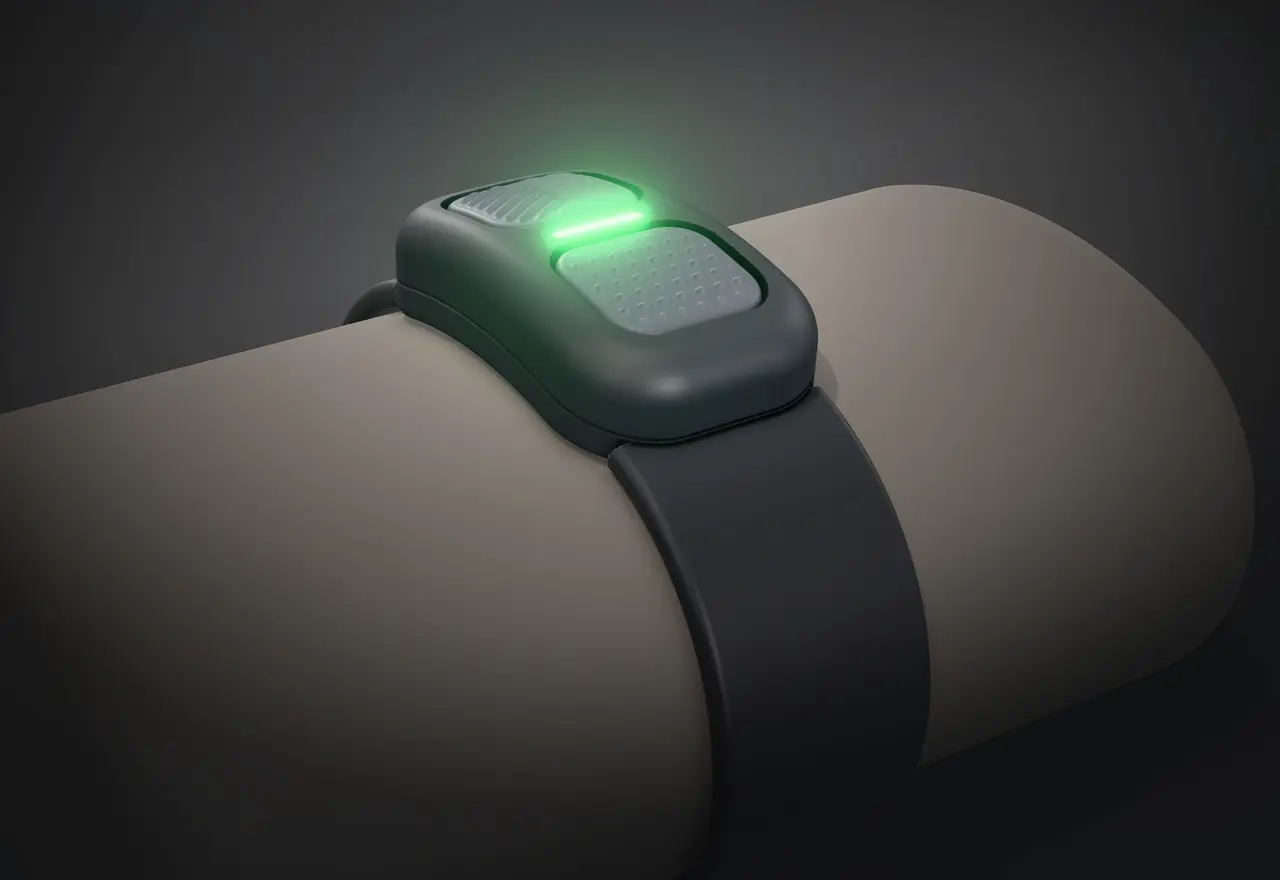
A screen on each court with a small box behind it, and a two-button wristband. Score and levels on the screen, history and rankings on every player's phone.
In development: the wristband and the court box.
Built and tested: the scoring code and the screen's scoreboard.
A screen on each court with a small box behind it, and a two-button wristband. Score and levels on the screen, history and rankings on every player's phone.
In development: the wristband and the court box.
Built and tested: the scoring code and the screen's scoreboard.
The demo
Try it on your phone
It opens a demo on your phone, where you set up and play a match from start to finish.
Open the demoThe other players, the email and the wristband are simulated. Scores and levels come from the real code.

For the club
What the club gets
-
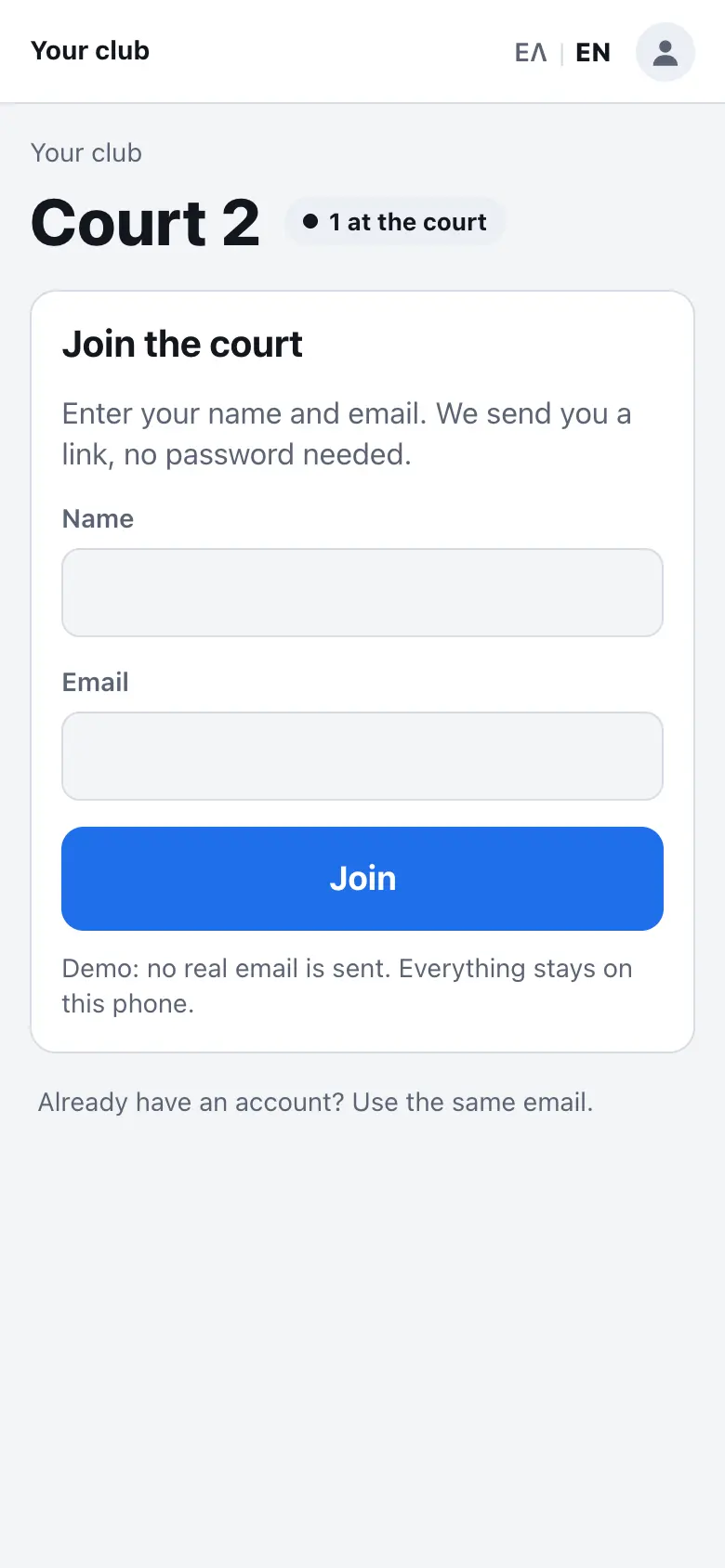
Players set up the court themselves from the QR on the court screen. Reception doesn't touch it.
-
The court screen shows who is playing, a score everyone on court can read, and each player's level change after the match.
-
Every match goes into each player's history with a level, so there's a reason to book again.
-
Rankings inside the club.
-
Numbers for you: matches per court, busy hours, who comes back.
How it works
A match, step by step
They scan the QR on the court screen.
One of them sets up the match from whoever joined, and the teams show on the screen.
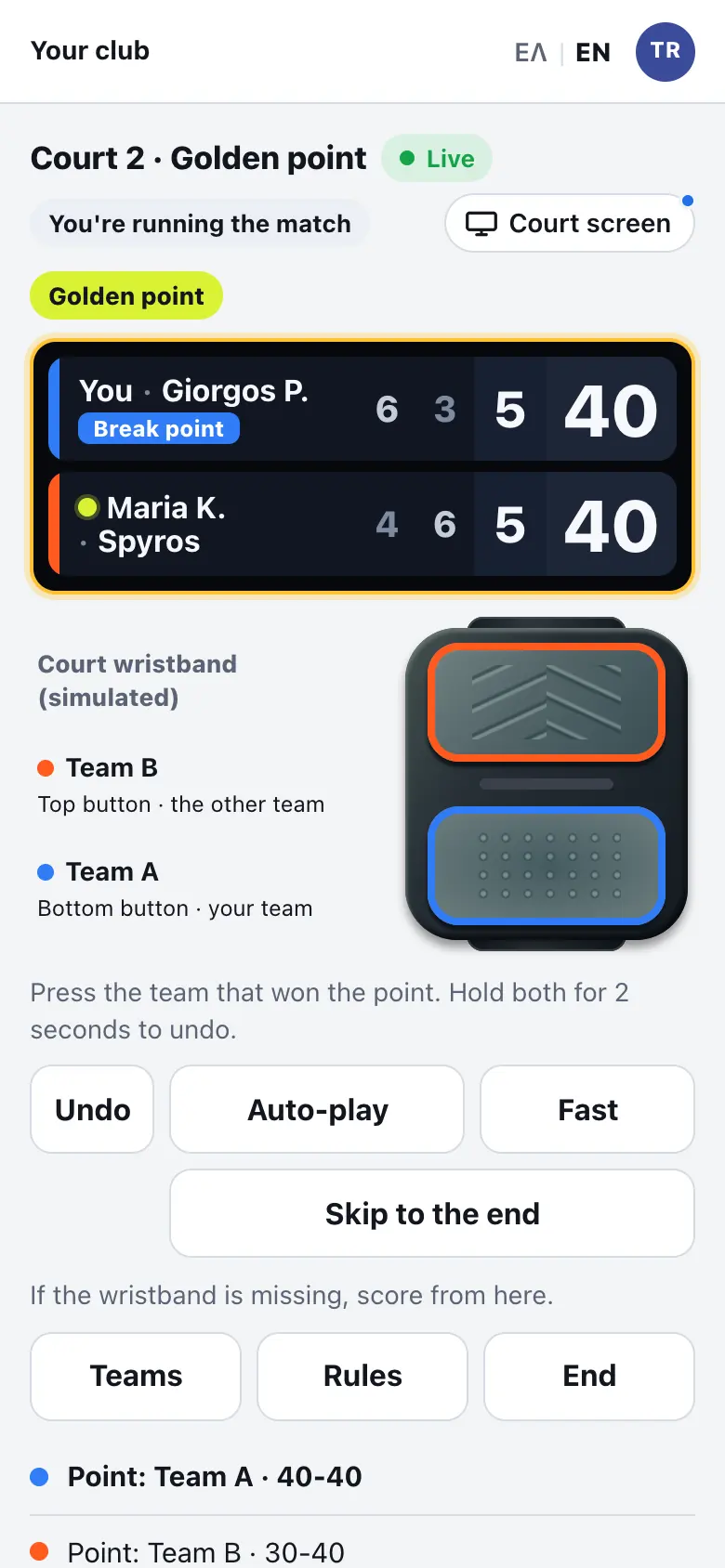
One of them wears the wristband. After each point they press the bottom button if their team won it, or the top one if the other team did. The score goes up on the screen.
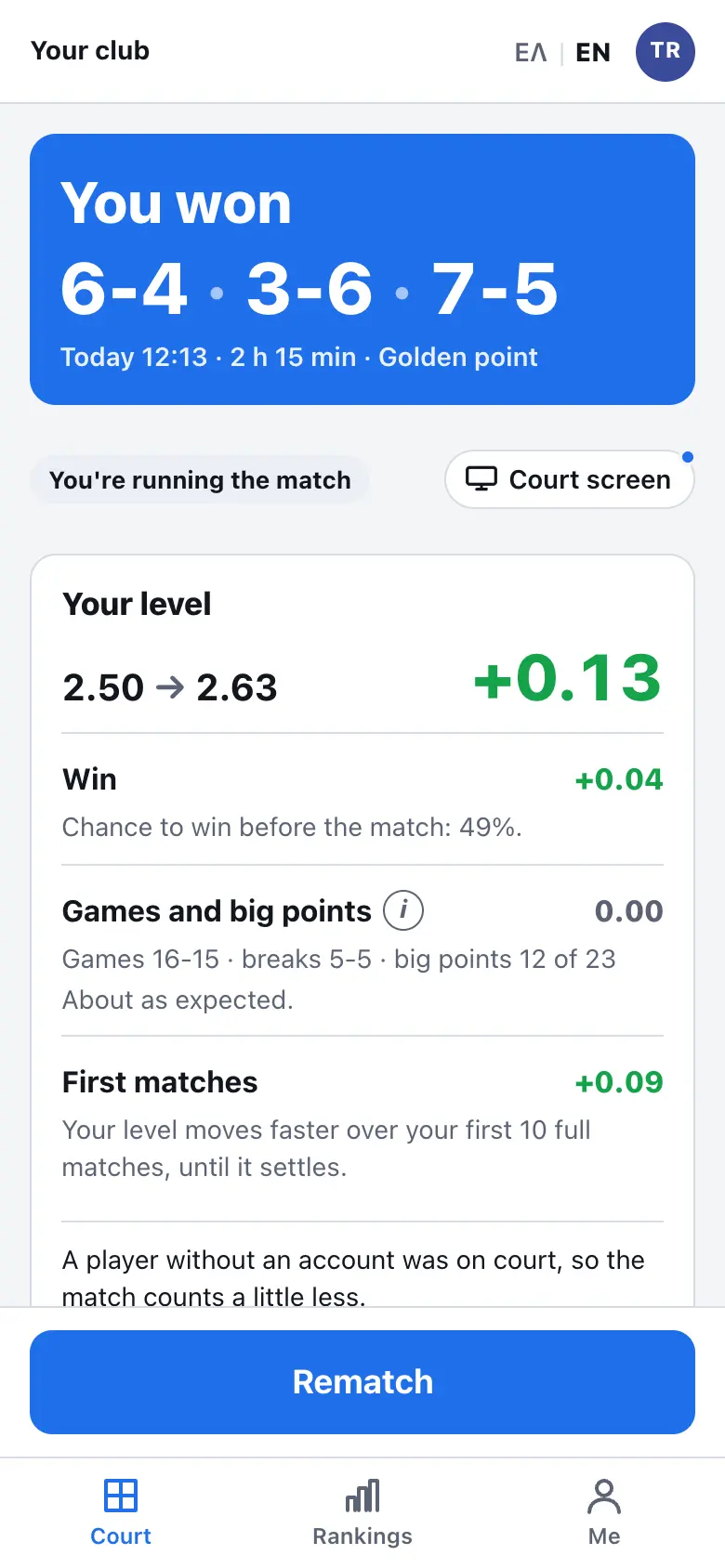
At the end everyone has the result and their level, on the screen and on their phone.
Nobody got a phone out? Whoever wears the wristband holds both buttons for 2 seconds and the match starts. Names go in whenever they scan.
The wristband →The screen
The court screen
One per court: a screen with HDMI, or a TV the club already has.
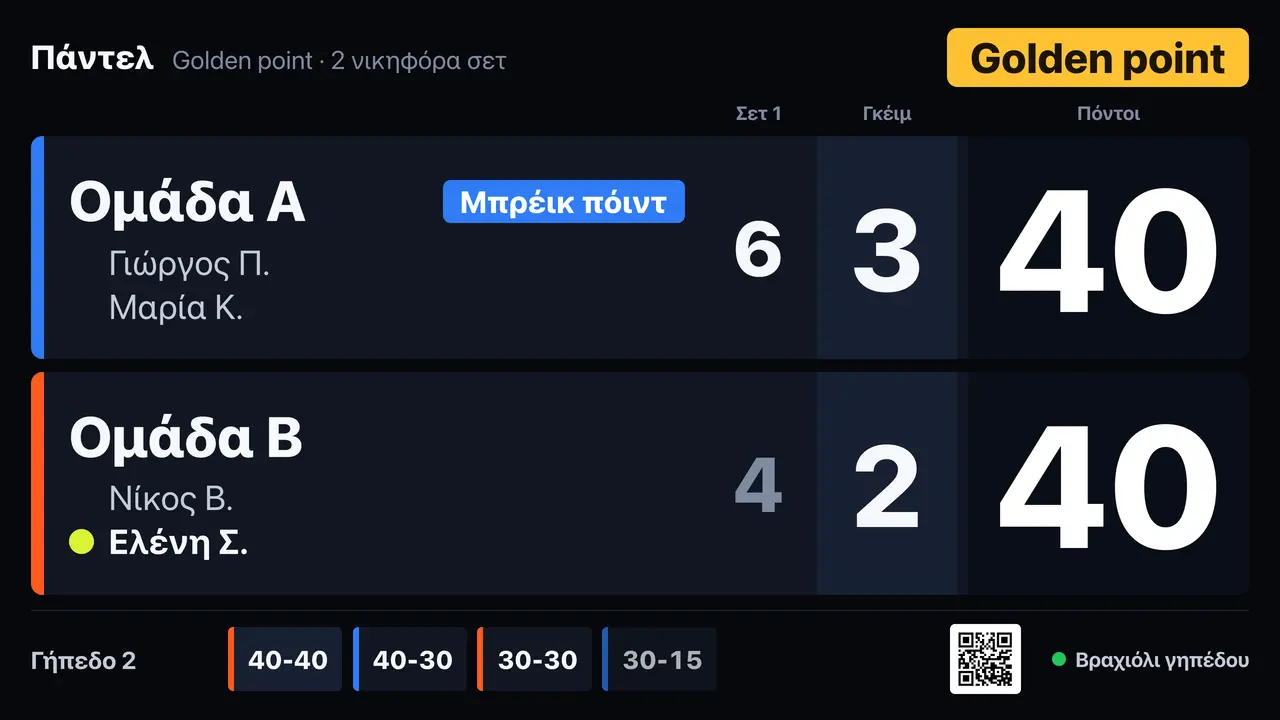
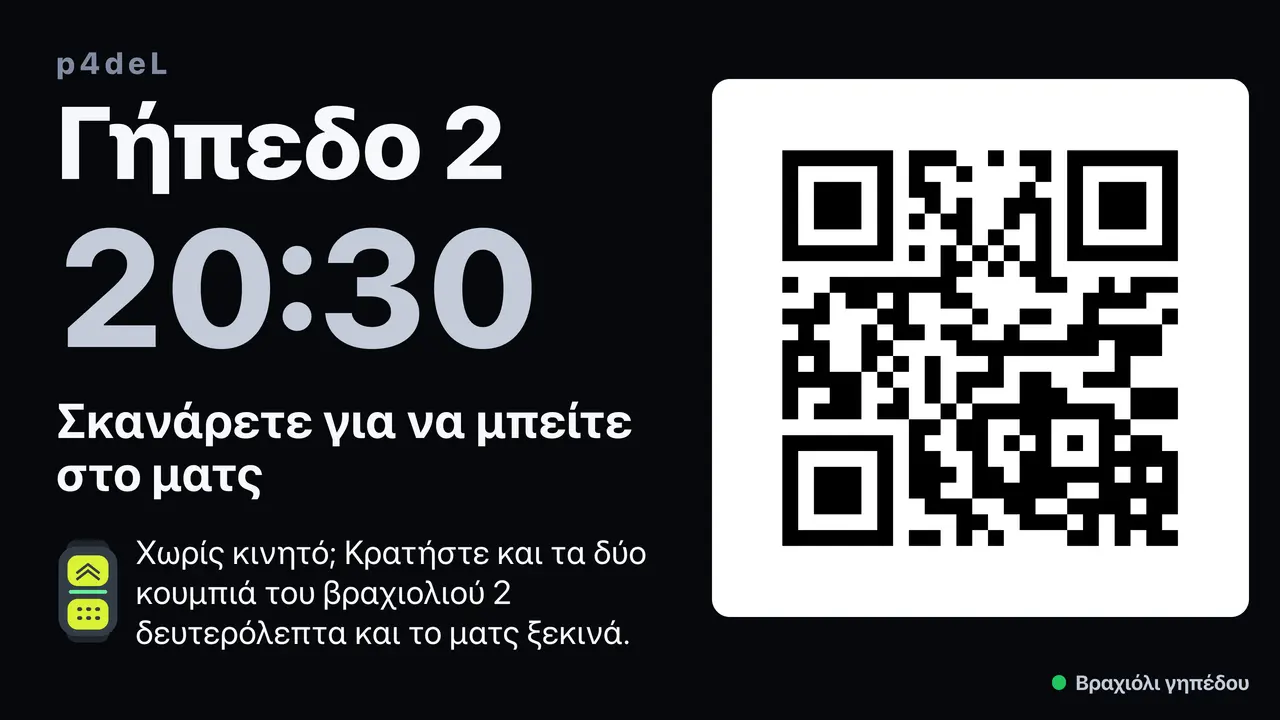
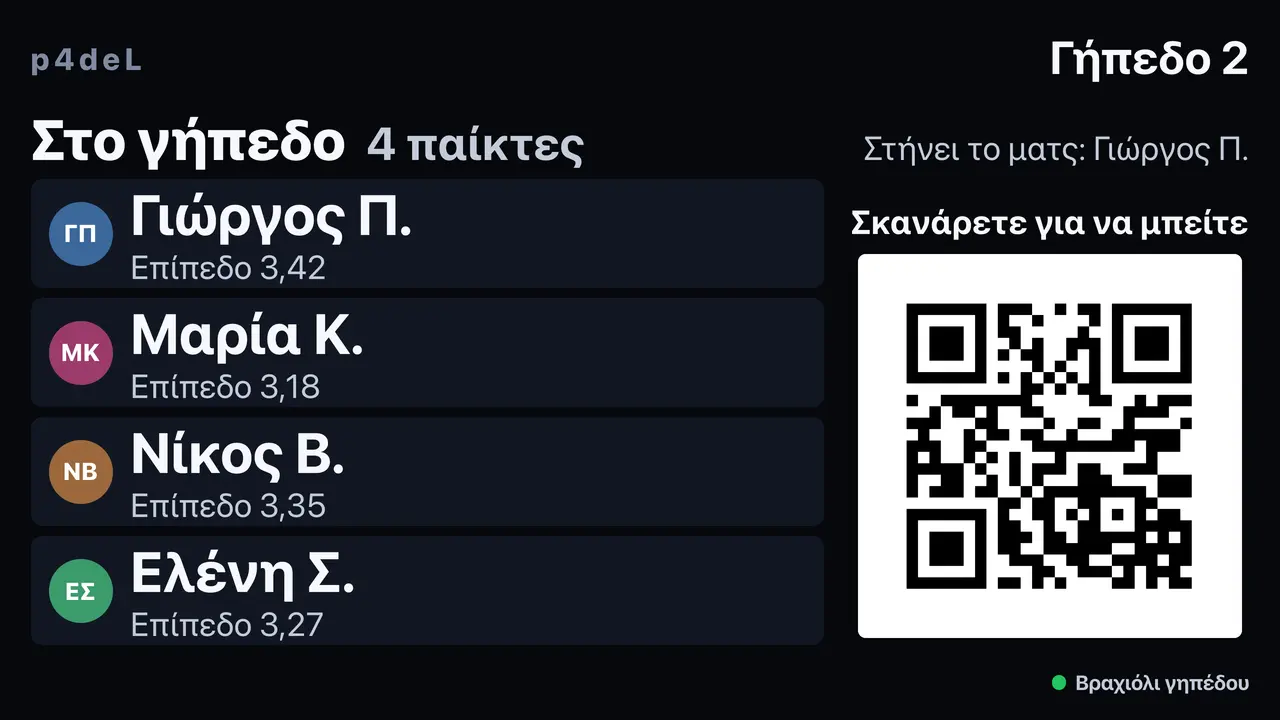
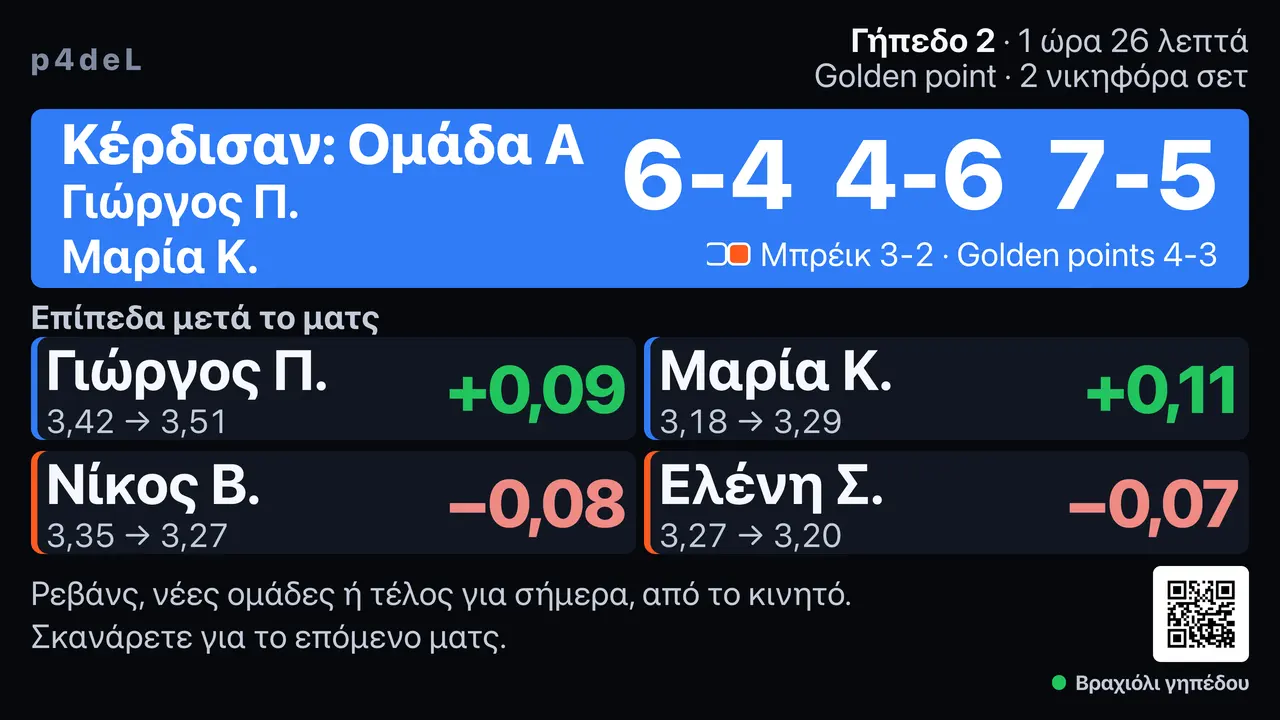
Pictures drawn by the court screen's own code, with example names. The screen speaks Greek.
When the court is free it shows the QR, the clock and how to start from the wristband, with no names. Names and levels show only while a match is on: who joined, the teams as they form, the live score in large type with a small QR for late arrivals, and each player's level change right after the end.
- For indoor courts, 50 inches or more, so names read from the court (goal).
- The court box drives it over HDMI, so it keeps showing the score with no internet.
- The QR on the screen can change, so a photo of it doesn't open the court from home.
- If the screen is off, reception puts up a printed QR that opens the same court on phones.
- Trials will show which screens stay readable on outdoor courts in sunlight.
For players
A level after every match, rankings inside the club.
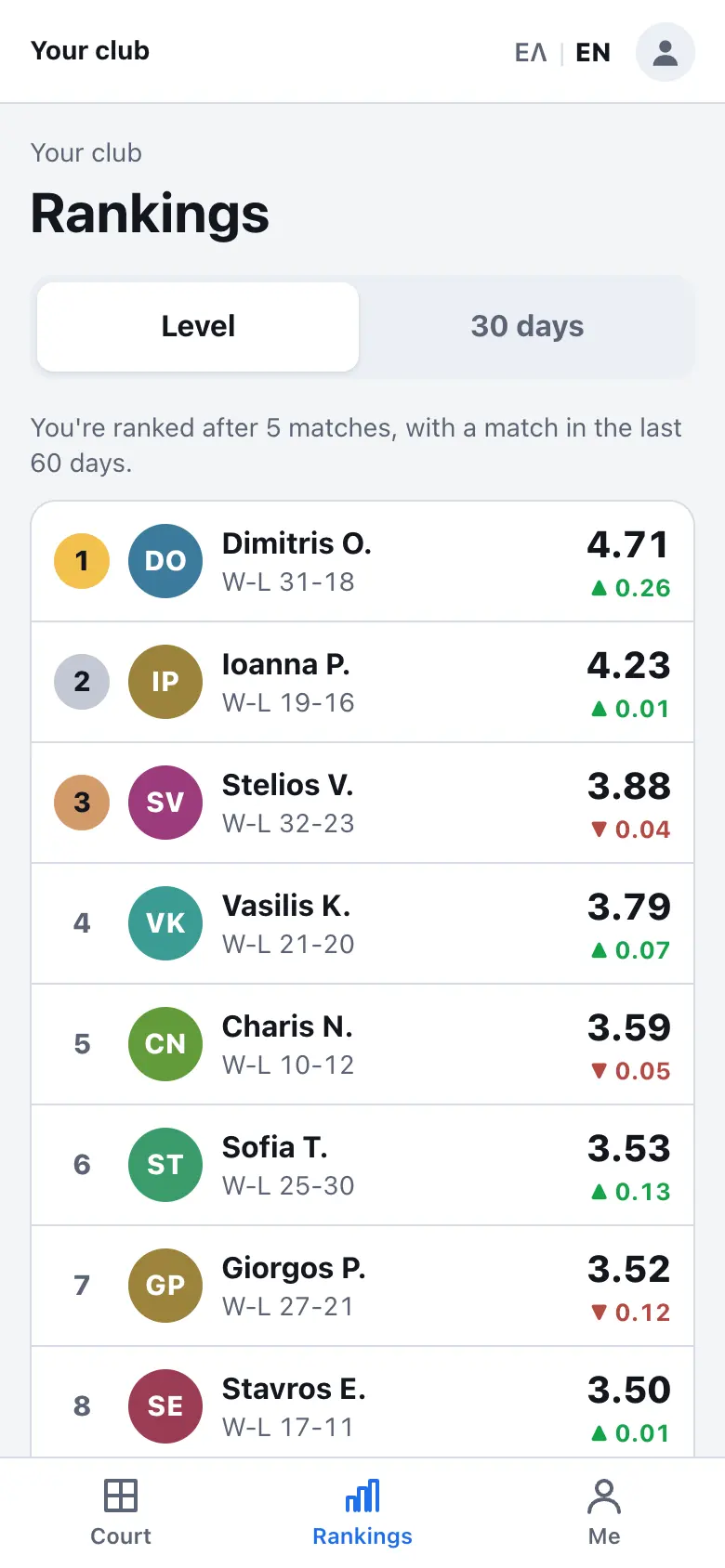
How levels work
- Everyone has a level from 0 to 7. Anyone who doesn't pick one starts at 2.50.
- Beating a stronger pair gains more. Losing to a weaker pair costs more.
- Games, breaks and big points count a little, always less than the result. A win never lowers your level and a loss never raises it.
- A match stopped before the end counts by the games difference, at most half.
- Your level moves faster in your first 10 matches. You're ranked after 5.
History and levels
The wristband knows which team won the point but can't tell which player, so partners share the same stats.
Head-to-head and partners on every profile. Players without a phone keep their matches and can claim them later.
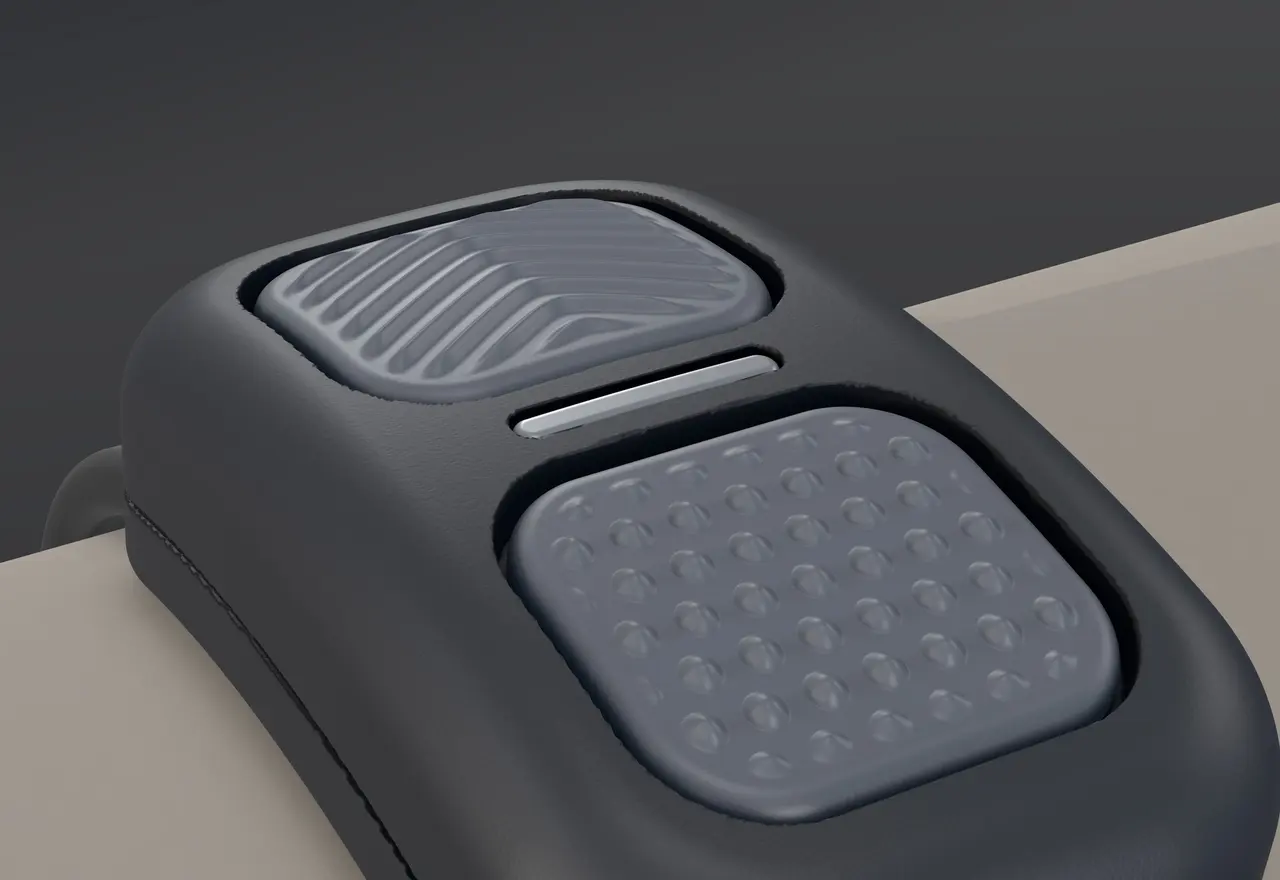
On the wrist
The wristband
Two buttons and a buzz, no display on the wrist.
- The bottom button, with the dots, gives the point to the wearer's team. The top one, with the ridges, to the other team.
- Between them, a light bar: green with a short buzz when the point counted, red with a long buzz to press again.
- Both buttons for 2 seconds: undo during a match, a new match when the court is free.
- One per court, worn by one player who scores for both teams. Charged at reception.
- Talks to the court box over Bluetooth.
- If it's forgotten or flat, the match is scored from a phone.
In development: size, battery and case get settled in trials with the first clubs.
The wristband →No cables across the court
How a point travels
The court box
- A small computer (a Raspberry Pi) mounted behind each court's screen. It talks to the wristband, keeps the score, writes down every event with its time and drives the screen.
- Needs a socket, the club's internet (Wi-Fi or cable) and a short HDMI cable to the screen. No cables across the court.
- One box per court, so a fault stops only that court. It can get smaller later.
In development: today the box software runs on a computer with simulated wristbands, with the Raspberry Pi setup ready.
When the internet drops
- The wristband, the box and the court screen don't need internet. The match goes on, the screen shows every point, and a match can still start from the wristband.
- The box writes down every point with its time and sends them all once the line is back. Nothing is lost.
- Phones stop updating until the line is back, then catch up.
- A match already running carries on, and the wristband starts one.
Without internet at the club, nobody can join or add a name from a phone, no match can be set up from a phone, the score doesn't reach phones, and new levels come once it's back.
See what the box keeps →What the club installs, and what it doesn't
You install, per court
- A screen with HDMI (or a TV you already have) where players can see it
- The court box, behind the screen
- Power and the club's internet at that spot
- A wristband
- A printed QR at reception, for when the screen is off
You don't need
- Cables across the court
- Anything on players' phones
- A change of booking system
Rules
Scoring rules
- Padel: golden point, star point (FIP 2026: two advantages, then a deciding point), advantage, super tie-break to 10, tie-break at 6-6, change of ends.
- Tennis: best of 3 or 5 sets, no-ad doubles.
- Pickleball: side-out and rally scoring.
- An undo or a rule change rescores the match from its recorded points.
Later: changing the serving order each set.
You asked
Questions from the court
Does every court need a screen?
Yes, a screen or a TV you already have, with the court box behind it.
We have 6 courts. Do we need 6 TVs?
Yes, one screen and one box per court. If a box breaks, only that court stops.
Do we need a new TV?
For indoor courts, a TV of 50 inches or more with HDMI (goal, trials will confirm). One you already have will do if it's that size. Outdoor courts need a brighter screen, which trials will settle.
Outdoor courts, in the sun?
Outdoors needs a brighter screen. Trials will show which ones stay readable in sunlight.
What if the screen is off or broken?
Reception keeps a printed QR for each court, and the score shows on phones.
The internet drops?
The screen and the wristband carry on, because they connect straight to the court box, and the wristband starts a new match too. The box keeps every point with its time and sends them all once it's back. That's when phones update and names go in.
Which names show on the screen?
First name, surname initial and level, only while a match is on. When the court is free the screen shows no names. Never an email.
Someone has no phone?
They go in by name.
Forgot the wristband?
The score goes in from a phone.
Pressed the wrong team?
Hold both buttons for 2 seconds, or Undo on the phone.
Rain or sweat?
Designed for both (goal). Still to be tested.
How often does it charge?
We'll measure it on the first prototypes. No number yet.
Privacy
- A player account will be a name and an email. No password, no phone number, no location, no contacts.
- Other players will see first name, surname initial, level and matches at this club.
- The court screen will show the first name, surname initial and level of whoever joined that court, and the score, only while a match is on: from the lobby to the result right after it. When the court is free it shows no names. Never an email.
- Anyone will be able to hide from the rankings, get a copy of their data, or delete their account. Past matches will stay for the other players as "Former player".
- Players without an account: a first name only. Unclaimed names will be deleted after 12 months.
- Under 15 (the Greek age for digital consent): they will play as players without an account.
- The club will see rankings and totals, never players' emails.
- The wristband will carry no personal data, only which button was pressed and when. The box will have no camera and no microphone.
- Data will be hosted in the EU, with a processing agreement for each club.
For the technically minded
- Wristband: nRF52840 over Bluetooth Low Energy.
- Every point is stored as an event and the score is worked out again from the start, so an undo or a rule change leaves nothing wrong behind.
- The wristband's button and sending logic is checked against the same test scenarios as its model on the computer.
- The court screen is a full-screen browser page on the box, drawn with the same screen code you saw in the demo.
- The same scoring code runs in the box and on phones, and will run in the cloud too.
Where it stands
- Today
The scoring software and the court screen's scoreboard work and are tested with simulated wristbands, on a computer, with the Raspberry Pi setup ready.
- Next
Wristband prototypes, then a pilot at a few clubs, then CE marking before any sale.
- With the cloud
Later: names, teams and levels on the court screen, with the cloud.
The first clubs
Want to be one of the first clubs? Talk to us.
The wristband is in development and we are looking for a few clubs to try it in real matches before it goes on sale.
In development: the wristband and the court box.
Do you play padel?
Leave us your email and we'll write when p4deL reaches a club near you.
Leave your email →